Lead Response Time Stats: 78% of Deals Go to the First Responder

How Bad Is the Average Real Estate Lead Response Time?
The average lead response time in real estate investing is 3-5 hours. Some studies put it even higher. That means the typical investor is operating in the 1-2% conversion zone for most of their leads, paying premium prices and then treating those leads like cold calls.
Why the Data Should Change How You Operate
You were in a meeting. You were driving. You were eating dinner. You were going to call them back first thing in the morning.
The data doesn't care. Real estate lead response time statistics are brutal and they don't make exceptions for busy schedules.
What This Article Covers
Every study on lead response in real estate says the same thing: faster wins. Here are the numbers, what they actually mean for your business, and what the top-performing investors are doing differently.
What Are the Key Response Time Benchmarks Every Investor Should Know?
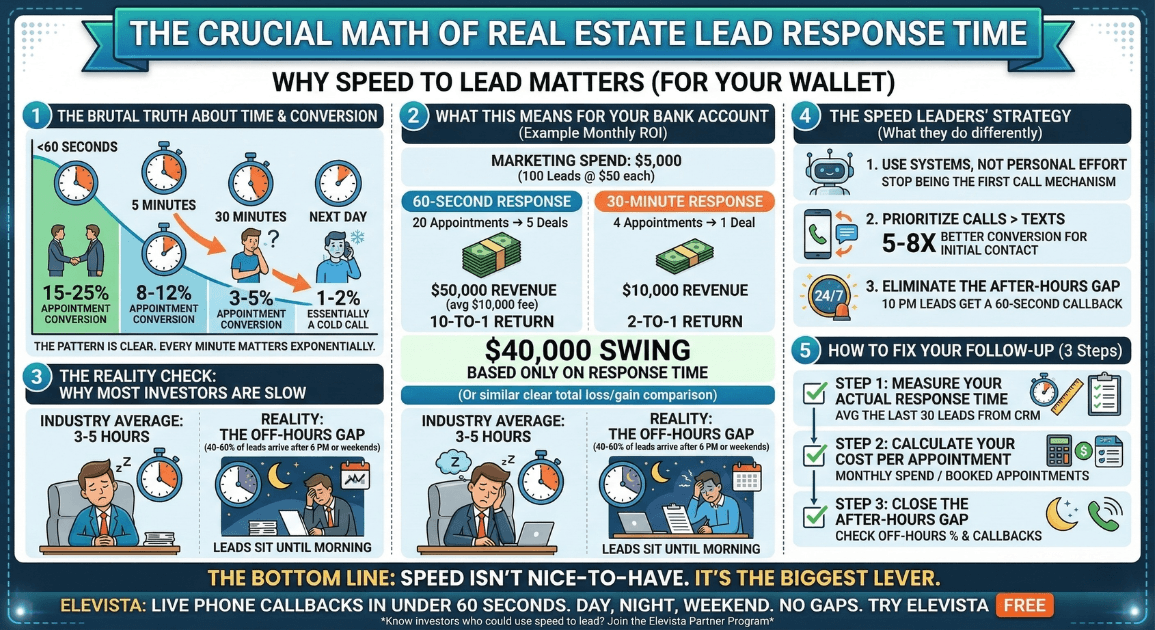
These real estate lead response time statistics come from industry studies, CRM data, and performance numbers across hundreds of investors using various response systems. The pattern is consistent: every minute you wait, conversion drops exponentially.
The 60-Second Window
Leads contacted within 60 seconds of form submission convert to appointments at 15-25%. That's not a typo. One out of every four or five leads turns into a booked meeting when you call back within a minute.
The 5-Minute Cliff
Wait five minutes and conversion drops to 8-12%. Still decent. Still worth the call. But you've already lost a third of your potential appointments just by waiting four extra minutes.
The 30-Minute Wasteland
At the half-hour mark, you're looking at 3-5% conversion. The seller filled out your form, got distracted by something else, and now your call is an interruption rather than a continuation. You're competing with whatever they moved on to.
The Next-Day Graveyard
Call the next morning and your conversion rate is 1-2%. That lead cost you $40-80 to generate. You just turned it into a cold call. Same response rate as dialing a skip-traced list.
The pattern is clear. The first five minutes matter more than the next five hours.
How Do Response Time Statistics Translate to Actual Revenue?
Statistics are abstract until you attach dollar signs. The revenue impact of response time is dramatic, and most investors underestimate it by a factor of 5-10x.
The Math on 100 Leads Per Month
Say you generate 100 leads a month at $50 per lead. That's $5,000 in marketing spend. Here's what different response times do to your return:
60-second response: 20 appointments booked. At a 25% close rate, that's 5 deals. If your average assignment fee is $10,000, that's $50,000 in revenue from $5,000 in spend. Ten-to-one return.
30-minute response: 4 appointments booked. One deal. $10,000 from $5,000. Two-to-one return.
Next-day response: 1-2 appointments booked. Maybe a deal, maybe not. You might break even. You might lose money.
The $40,000 Swing
Same leads. Same marketing. Same market. The only variable is how fast you picked up the phone. That's a $40,000 swing based on nothing but response time.
When "Marketing Isn't Working," Check Response Speed First
When investors tell us their marketing isn't working, the first thing we check is response speed. Nine times out of ten, the marketing is fine. The follow-up is killing the ROI.
For a deeper look at what those lost leads actually cost over time, The True Cost of Missed Real Estate Leads runs the full math.
Why Is the Industry Average Response Time So Bad?
The average response time of 3-5 hours isn't caused by laziness. It's a structural problem built into how most real estate investing businesses operate.
The Five-Hat Problem
The typical investor is one person wearing five hats. They're finding deals, analyzing deals, negotiating deals, coordinating closings, and managing buyers, all while trying to call back every lead within five minutes. Something has to give, and the thing that gives is always the new lead that just came in.
The After-Hours Gap
Industry data shows 40-60% of real estate leads come in after 6 PM or on weekends. These are often the highest-motivation leads: people sitting at home at night, stressed about a foreclosure or a vacant property, finally deciding to fill out a form.
Those leads sit until morning. By then, every other investor who was also running ads has already called. The lead that submitted at 10 PM with genuine urgency gets a callback at 9 AM from someone they barely remember. That's 11 hours of lost momentum.
Manual Follow-Up Is the Default (and the Problem)
The real estate lead response time statistics tell the story clearly: the industry average is terrible, and terrible is the default for anyone who relies on manual follow-up.
What Do Speed Leaders Do Differently?
The investors who consistently hit 60-second response times didn't get there by being more disciplined or working longer hours. They made three specific structural changes to how their business handles leads. The complete guide to speed to lead walks through what each of those changes looks like in practice.
They Stopped Being the Response Mechanism
The fastest response you can personally deliver still depends on whether you're free when the lead comes in. The investors who solved speed took themselves out of the first-call equation entirely. They use systems (AI, dedicated teams, automated callbacks) that respond regardless of what the investor is doing.
They Prioritized Calls Over Texts
Texting feels fast. You can fire off an SMS in seconds. But the data is clear: a phone conversation converts 5-8x better than a text message for initial contact. The speed leaders know that a 60-second callback beats a 5-second text every time.
They Eliminated Off-Hours Gaps
No coverage gap means no leads sitting overnight. The top performers respond at 10 PM the same way they respond at 10 AM. The leads that come in when nobody else is answering are the easiest wins, and the speed leaders collect every one of them.
How Can You Use These Statistics to Fix Your Business?
You don't need to memorize every data point. You need to take three specific actions that directly address the response time problem. Here's the framework.
Step 1: Measure Your Actual Response Time
Pull your last 30 leads from your CRM. For each one, calculate the time between form submission and first live contact. Not first text. First actual conversation. Average those numbers. That's your baseline, and it's probably worse than you think.
Step 2: Calculate Your Cost Per Appointment
Take your monthly marketing spend and divide it by booked appointments. If that number is over $100, your response time is almost certainly the problem. Every minute you shave off response time pushes that number down.
Step 3: Close the After-Hours Gap
Check what percentage of your leads arrive outside business hours. If it's 40%+ and those leads aren't getting callbacks within 60 seconds, you're leaving your best opportunities untouched for 12+ hours.
Elevista handles all three. Every lead gets a callback in under 60 seconds: a live phone conversation, not a text. It qualifies the seller, gathers the details, and books the appointment on your calendar. Day, night, weekend, holiday. No gaps.
The real estate lead response time statistics are clear. Speed isn't a nice-to-have. It's the single biggest lever you have for getting more deals from the leads you're already paying for.
Frequently Asked Questions
What is the average lead response time in real estate?
The average lead response time in real estate investing is 3-5 hours. Some studies put it even higher. This means most investors are operating in the 1-2% conversion zone for the majority of their leads, effectively turning paid leads into cold calls.
What conversion rate can I expect if I respond in under 60 seconds?
Leads contacted within 60 seconds convert to appointments at 15-25%, according to data from the MIT Lead Response Management Study published in Harvard Business Review. That drops to 8-12% at 5 minutes, 3-5% at 30 minutes, and 1-2% when you wait until the next day.
How much revenue do slow response times cost per year?
Based on typical lead flow of 100 leads per month at $50 each, the difference between 60-second and next-day response can represent a $40,000 per month revenue swing. Over a year, that compounds to hundreds of thousands in lost deals from the same marketing spend.
What percentage of real estate leads come in after business hours?
Industry data shows 40-60% of real estate leads arrive after 6 PM or on weekends. These are often the highest-motivation sellers, making after-hours coverage critical for maximizing conversion rates and capturing your best opportunities.
How do top-performing investors achieve fast response times?
The top performers removed themselves from the first-call equation entirely. They use AI callback systems or dedicated teams that respond 24/7, prioritize phone calls over texts (which convert 5-8x better), and eliminate all after-hours coverage gaps.
What's the Bottom Line on Lead Response Time?
Real estate lead response time statistics aren't just numbers on a page. They're the math behind every deal you close and every deal you lose.
Sixty seconds gets you 15-25% conversion. Five hours gets you 1-2%. That's the same lead, the same seller, the same property. The only difference is whether you called while they were still thinking about selling or after they'd moved on.
You already paid for the lead. The only question is whether you'll get the meeting.
For the tactical moves that turn a fast first call into a closed deal, see our full playbook on real estate lead conversion tips — it covers the qualification, follow-up, and no-show reduction tactics that compound on top of speed-to-lead.
Try Elevista free and get every lead called back in under 60 seconds
Know investors who blame their marketing when the real problem is response time? Join the Elevista Partner Program and earn recurring commissions every time you refer someone who's ready to stop leaving money on the table.
Frequently Asked Questions
What is the average lead response time in real estate?
What conversion rate can I expect if I respond in under 60 seconds?
How much revenue do slow response times cost per year?
What percentage of real estate leads come in after business hours?
How do top-performing investors achieve fast response times?
Get insights delivered weekly
Join real estate investors who get speed-to-lead strategies and product updates every week.