Why 60-Second Callbacks Convert at 22% (4% at 5 Min)

Why Can't You Respond Fast Enough, Even When You Know You Should?
Every article about real estate lead conversion says the same thing: respond faster. Call them back immediately. The first caller wins. You know this. The information isn't the problem.
The problem is nobody tells you how to respond to real estate leads fast when you're one person running an entire operation. You can't sit by your phone 24 hours a day. You can't clone yourself. And "just be faster" isn't a strategy.
The Gap Between Knowledge and Execution
You've read the stats. You've felt the sting of losing a deal because you called back four hours late. So let's skip the obvious advice and talk about what actually works. Not theory. Not platitudes. The mechanics of building a system that responds to every lead in under 60 seconds, regardless of when it comes in or what you're doing.
What This Guide Covers
We'll walk through why this is a structural problem, compare the three main response methods, put real numbers on each response window, and give you the practical framework for getting to 60-second response times.
Why Is Slow Lead Response a Logistics Problem, Not a Discipline Problem?
Most investors can't respond fast because their day doesn't have room for it. This is a structural problem built into the nature of running a real estate investing business, not a personal failing.
The Typical Investor's Day
You're driving to an appointment at 2 PM when a lead comes in. You're on a call with your title company at 4 PM when another one hits. You're at dinner with your family at 7 PM when three more arrive. By the time you sit down to return calls at 9 PM, those leads have been sitting for hours.
Removing Yourself as the Bottleneck
The investors who've figured out how to respond to real estate leads fast didn't get better at time management. They stopped trying to be the response mechanism entirely.
Think about it this way: a restaurant doesn't rely on the owner to answer the phone. They hire a hostess. Your lead response shouldn't depend on whether you happen to be free when the phone rings.
Which Lead Response Methods Actually Work?
There are really only three ways to handle inbound lead response. Two of them fail at scale, and only one truly solves the speed problem.
Method 1: You Do It Yourself
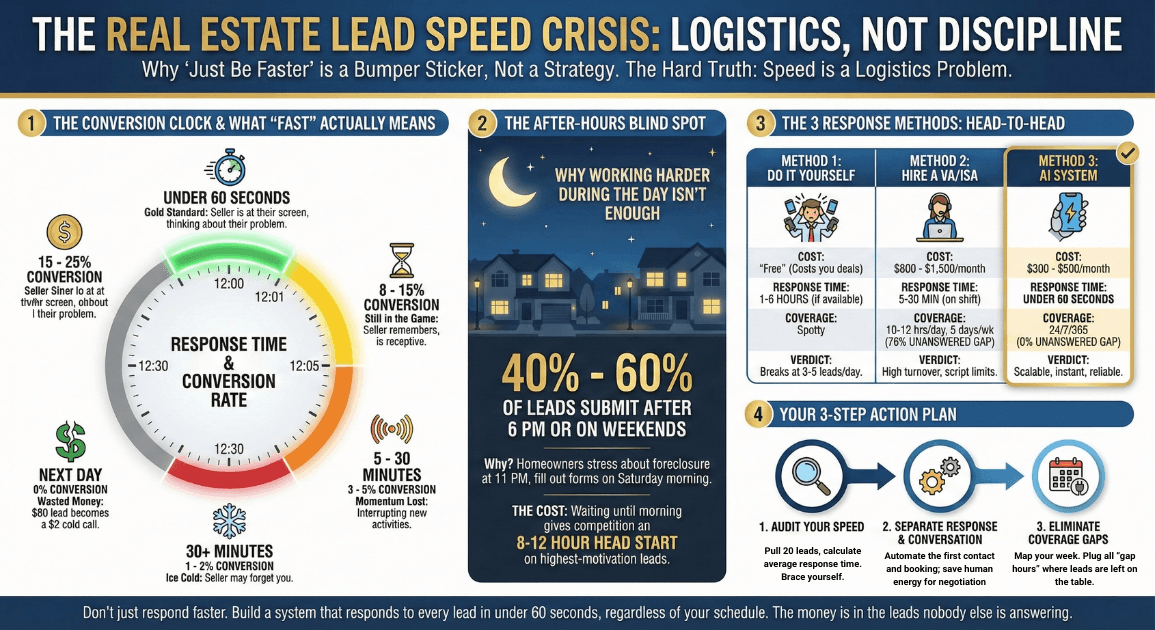
Average response time: 1-6 hours when you're available, infinity when you're not. You catch maybe 40% of leads within the first hour. The other 60% wait. Some wait until morning. Some wait until Monday. Some never get called at all because they got buried under newer leads.
This works when you have 3-5 leads a week. It breaks completely at 3-5 leads a day.
Method 2: You Hire Someone to Do It
A VA or ISA brings your coverage to maybe 10-12 hours a day, 5 days a week. Better than doing it yourself, but you still have 128 hours a week with zero coverage. That's 76% of the week where leads sit unanswered.
Then there's the quality issue. Your VA follows a script. When a seller says something the script doesn't cover, the conversation stalls. When your VA has a bad day, every lead that day gets a subpar experience. When they quit (and industry estimates suggest the average tenure is 3-6 months), you're starting from scratch.
Cost: $800-$1,500/month for a dedicated caller. Response time during their shift: 5-30 minutes. Response time outside their shift: doesn't exist.
Method 3: An Automated System That Removes Human Availability
This is where AI lead response lives. Every lead gets a callback in under 60 seconds. Not a text. Not an email. A live phone conversation that qualifies the seller and books the appointment.
No off-hours. No sick days. No script limitations. No quitting after three months.
Cost: $300-$500/month. Response time: under 60 seconds. Coverage: 24/7/365.
The math isn't complicated. The only method that actually solves "how to respond to real estate leads fast" is the one that removes human availability from the equation entirely.
What Do Specific Response Times Actually Mean for Conversion?
"Respond quickly" is vague. Here are the real numbers so you know exactly what each response window costs you in deals and dollars.
The 60-Second Gold Standard
Leads contacted within one minute convert at 22%. The seller is still sitting at their computer or holding their phone. They're still thinking about their problem. They haven't moved on to something else yet. According to the MIT Lead Response Management Study, this is the peak engagement window.
The 1-to-5-Minute Window
Still good. Conversion rates drop to 11%, but you're in the game. The seller remembers filling out the form. They're receptive.
The 30-Minute Dropoff
You've lost the moment. Conversion drops to 4%. The seller has moved on to other things. When you call, you're interrupting whatever they're doing now, not continuing the momentum of what they just did.
Beyond 30 Minutes
You're essentially cold-calling someone who filled out a form. They may not even remember which company you're from. Conversion: 1-2%. Same as a cold call off a skip-traced list. As the Harvard Business Review documented, the odds of qualifying a lead drop dramatically with each passing minute.
Next day: That lead cost you $40-$80. You just turned it into a cold call worth $2.
The dropoff is steep and it's fast. The difference between 60 seconds and 60 minutes isn't incremental. It's the difference between a warm conversation and a cold call. The real estate lead response time statistics break down exactly what each window costs you.
Why Are After-Hours Leads Your Biggest Missed Opportunity?
After-hours leads represent the largest untapped revenue source for most investors. The sellers with the highest motivation submit forms at the times you're least likely to be available.
When Sellers Actually Fill Out Forms
Pull your lead data from the last 90 days. Check what time each lead submitted their information. For most real estate investors, 40-60% of leads come in after 6 PM or on weekends.
That makes sense. When do homeowners think about selling? Not during business hours when they're at work. They think about it at night. They fill out forms on Saturday morning while drinking coffee. They submit information at 11 PM when they can't sleep because they're stressed about the foreclosure notice on the counter.
The Overnight Head Start You're Giving Competitors
If you're responding to those leads the next morning, you're giving your competition an 8-12 hour head start on your best opportunities. That's not a small edge. That's the whole game.
Where the Real Money Is
The investors who know how to respond to real estate leads fast don't just respond fast during business hours. They respond fast at 10 PM on a Tuesday. They respond fast at 7 AM on Christmas morning. They respond fast when every other investor is asleep, at dinner, or at their kid's soccer game.
Not in the leads that come in at 2 PM on a Wednesday. Everyone competes for those. The money is in the leads that come in when nobody else is answering.
How Do You Build a 60-Second Response System?
Here's the practical framework for getting your response time under 60 seconds, regardless of your current setup. For the full reference behind this approach, the speed to lead playbook covers the data, the math, and the system end to end. The goal is removing yourself from the response chain entirely.
Step 1: Audit Your Current Speed
Go into your CRM right now. Pull the last 20 leads. For each one, note the time between form submission and first contact. Calculate the average. That's your baseline. Most investors are shocked when they see the actual number.
Step 2: Separate Response from Conversation
The biggest mistake is trying to be the person who both answers and qualifies. You can't do both at scale. The response needs to be automated. The in-depth negotiation can still be you, but only after the lead is qualified and the appointment is booked.
Step 3: Eliminate All Gaps in Coverage
Map out your week. When are you unavailable? Driving? In meetings? Sleeping? Those are your gap hours. Any lead that comes in during gap hours is money you're currently leaving on the table. Your system needs to cover every single one of those hours.
Step 4: Automate the Booking, Not Just the Contact
Making contact fast is only half the equation. If you call back in 60 seconds but then say "great, I'll have someone call you to schedule," you've just introduced another gap. The appointment needs to be booked in the same conversation as the first contact. One call. Qualify. Book. Done.
That's exactly what Elevista does. Lead comes in. AI calls back in under 60 seconds. Conversation happens: not a script, a real conversation that qualifies the seller's situation, timeline, and motivation. If they're a fit, the appointment lands on your calendar with the address, seller name, and key details. You wake up, check your calendar, and drive to meetings.
Frequently Asked Questions
What is the fastest way to respond to real estate leads?
The fastest method is an automated AI callback system that calls every lead within 60 seconds, 24/7. This removes human availability from the equation and ensures no lead sits unanswered, even after hours or on weekends. Manual methods cap out at whatever your personal availability allows.
How much does it cost to hire someone to answer leads?
A dedicated VA costs $800-$1,500 per month and covers 10-12 hours per day, 5 days a week. That leaves 76% of the week with zero coverage. An AI response system costs $300-$500 per month and covers 24/7/365, making it both cheaper and more reliable.
Why do most real estate investors respond too slowly?
It is a logistics problem, not a discipline problem. Investors are driving to appointments, on calls with title companies, and at family events when leads arrive. The business generates leads on a schedule you cannot control, so any system that depends on your personal availability will always have gaps.
What conversion rate can I expect at different response times?
Under 60 seconds: 22% conversion. 1-5 minutes: 11%. 5-30 minutes: 4%. Over 30 minutes: 1%. The dropoff is exponential, not gradual. The MIT Lead Response Study published in Harvard Business Review documents this pattern across millions of leads.
Should I text or call real estate leads first?
Always call. Phone conversations convert 5-8x better than text messages for initial contact. A live conversation within 60 seconds catches the seller while they are still engaged and thinking about their problem. Texts don't build the rapport needed to book an appointment.
What's the Bottom Line on Fast Lead Response?
Knowing how to respond to real estate leads fast isn't about working harder or being more disciplined. It's about building a system where speed doesn't depend on you being available.
Every lead deserves a callback in under 60 seconds. Not because it's a nice number. The data shows that's where conversion rates are highest and cost per appointment is lowest.
You can't be the fastest caller and the best closer and the smartest negotiator all at once. Pick the one that only you can do (closing deals at the kitchen table) and let a system handle the speed.
Try Elevista free and get every lead called back in under 60 seconds
Know investors who are always "too busy" to call leads back? Join the Elevista Partner Program and earn recurring commissions every time you refer someone who's ready to stop being the bottleneck.
Frequently Asked Questions
What is the fastest way to respond to real estate leads?
How much does it cost to hire someone to answer leads?
Why do most real estate investors respond too slowly?
What conversion rate can I expect at different response times?
Should I text or call real estate leads first?
Get insights delivered weekly
Join real estate investors who get speed-to-lead strategies and product updates every week.