
AI Calling for Real Estate: What It Does, What It Doesn't, and Why It Works
Why Is the Phone the Biggest Bottleneck in Real Estate Investing?
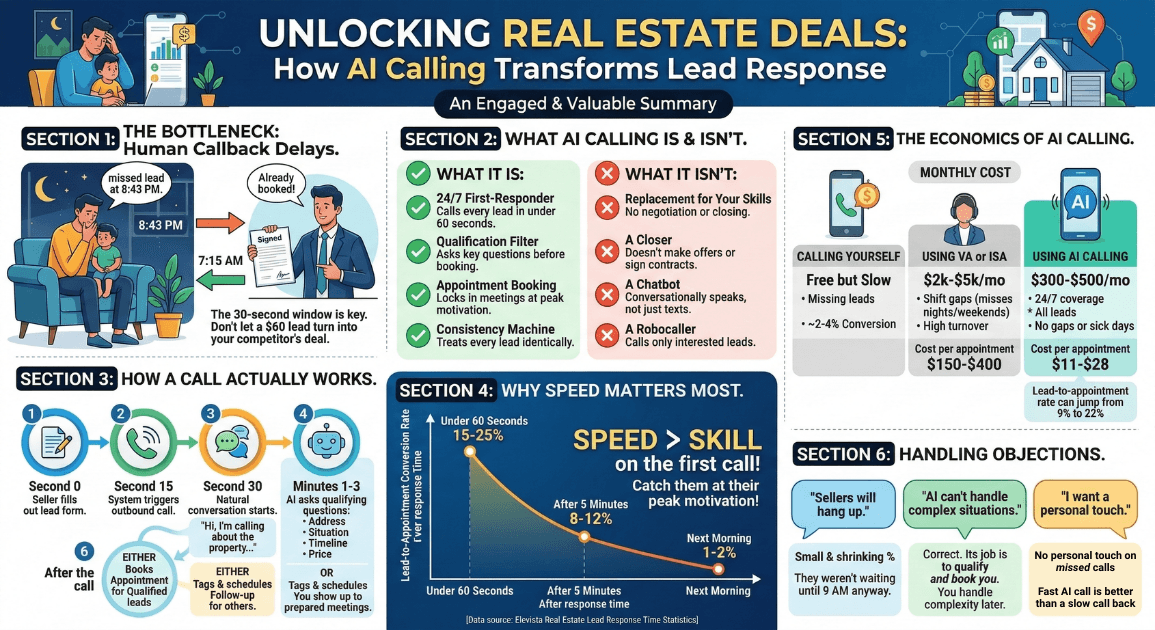
The phone is the single biggest bottleneck in every real estate operation that depends on manual callbacks. You built the marketing, targeted the zip codes, wrote the ads, and set up the landing pages. Then a lead came in at 8:43 PM while you were giving your kid a bath. You called back at 7:15 AM. The seller had already talked to someone else.
The marketing worked. The phone didn't. Or more accurately, you were not holding it at the right moment.
The 30-Second Window That Makes or Breaks Deals
There is a 30-second window between a seller raising their hand and someone picking up the phone. Miss that window and your $60 lead turns into your competitor's deal. According to the Lead Response Management Study by InsideSales.com, the odds of qualifying a lead drop dramatically after the first minute.
What AI Calling Solves
AI calling for real estate exists to eliminate the phone bottleneck entirely. Not to replace your negotiation skills. Not to close deals for you. To do the one thing you physically cannot do: answer every single lead, every single time, in under 60 seconds.
What Is AI Calling for Real Estate (And What Is It Not)?
AI calling for real estate means an automated system that places a live phone call to a seller within seconds of them submitting a lead form. The AI speaks conversationally, asks qualifying questions, listens to answers, and books appointments on your calendar, all without you touching your phone.
What AI Calling Does
- A 24/7 first-responder that calls every lead in under 60 seconds
- A qualification filter that asks the right questions before anything hits your calendar
- An appointment-booking system that locks in meetings at the moment of peak seller motivation
- A consistency machine that treats the 200th lead of the month identically to the first
What AI Calling Does Not Do
- Replace your kitchen-table negotiation skills
- Close deals, make offers, or sign contracts
- Send texts and hope for a reply like a chatbot
- Blast scripts at people who did not ask to be called (that is a robocall, not AI calling)
Where AI Fits in Your Deal Pipeline
The distinction matters. AI calling handles the first 60 seconds and the qualification conversation. You handle everything after the appointment is booked. The AI gets you in the door. You close the deal.
How Does an AI Phone Call Actually Work?
Most investors hear "AI phone call" and picture a stilted robot reading a script. The reality is very different. Here is what actually happens from the moment a seller submits a form to the moment you get a meeting notification.
The First 30 Seconds
Second 0: Seller fills out your lead form. Could be a Google ad, Facebook campaign, direct mail QR code, or website contact form.
Second 15: The system triggers an outbound call to the seller's phone number. The seller's phone rings while they are still looking at the confirmation page.
Second 30: The seller picks up. The AI introduces itself, references the form they just filled out, and starts a natural conversation. "Hi, I'm calling about the property you just submitted on. Is this a good time to chat for a couple minutes?"
The Qualification Conversation
Minutes 1-3: The AI asks qualifying questions: property address, situation driving the sale, timeline, mortgage balance, desired price range, and other decision makers involved. These are the exact questions you would ask if you were making the call yourself.
Minutes 3-5: Based on the answers, the AI either books an appointment on your calendar or tags the lead for follow-up. Qualified seller with urgency? Meeting booked for tomorrow. Seller who is six months out? Tagged and scheduled for a follow-up sequence. Tire-kicker who wants full retail? Politely ended and categorized.
What You Receive After the Call
You get a notification with the full conversation summary, qualification details, and (if qualified) an appointment on your calendar with the seller's address, situation, timeline, and contact info. You show up to a meeting with a seller who is expecting you and already told the system everything you need to know.
Why Does Speed Matter More Than Skill on the First Call?
The first call does not need to be great. It needs to be fast. This is the counterintuitive truth about AI calling for real estate, and research from InsideSales.com confirms it: response time is the single biggest factor in lead conversion.
The Psychology of Seller Motivation
Think about what happens in the seller's mind. They have been stressing about a property for weeks, maybe months. Tonight, they finally sat down and typed "sell my house fast" into Google. They filled out a form. Now they are sitting there, adrenaline still flowing, waiting to see what happens.
If the phone rings in 30 seconds, the seller thinks: these people are serious. They are organized. They respond immediately.
If the phone rings the next morning, the seller thinks: who is this? Oh right, I filled out some form last night. I am not sure I am ready to do anything yet.
What the Conversion Data Shows
The data backs this up. According to research published by Harvard Business Review, leads contacted within the first five minutes are far more likely to convert. At the 60-second mark, conversion to appointment runs 15-25%. Wait five minutes and it drops to 8-12%. Wait until the next morning and you are at 1-2%. The real estate lead response time statistics make the cost of every delay impossible to ignore.
Why AI Wins the Speed Race
AI does not need to be a better conversationalist than you. It needs to be a faster one. And at 60 seconds versus 4 hours (the average callback time reported by NAR's technology surveys), faster is not even close.
How Do the Economics of AI Calling Compare to Hiring Humans?
Most investors evaluate AI calling for real estate by comparing it to their current setup. Here is how the math typically plays out across three common scenarios.
If You Are Calling Leads Yourself
You are free, but you are slow. Average response time for a solo operator: 2-6 hours. You miss after-hours leads entirely. Your effective conversion rate on leads is 2-4% because most of them are stale by the time you call.
If You Are Using a VA or ISA
You are paying $2,000-$5,000/month for someone who works 40-50 hours a week, according to salary data from Glassdoor. They are faster than you during their shift, but they do not cover nights, weekends, or sick days. Cost per booked appointment: $150-$400. Turnover means you are retraining every 4-6 months.
If You Are Using AI Calling
You are paying $300-$500/month for 24/7 coverage. Every lead gets called in under 60 seconds. No shift gaps. No sick days. No turnover. Cost per booked appointment: $11-$28.
An investor in Denver was running a three-person operation: himself on acquisitions, a part-time VA for lead calls, and a transaction coordinator. The VA worked 25 hours a week and cost $1,800/month. She covered maybe 30% of the week. Leads that came in Friday evening sat until Monday morning.
He switched the first-call responsibility to Elevista and moved his VA to disposition and follow-up, work she was better at anyway. First month: lead-to-appointment rate jumped from 9% to 22%. He went from 8 booked meetings a month to 19. His VA was happier doing work that used her relationship skills instead of racing to answer phones. His cost per booked appointment dropped from $225 to $21.
He did not fire anyone. He just stopped asking humans to do a machine's job.
What Are the Common Objections to AI Calling (And What Are the Honest Answers)?
Every investor considering AI calling for real estate has the same three concerns. Here are the objections and the straightforward answers.
"Sellers Will Know It's AI and Hang Up"
Some will. The percentage is small and shrinking. Modern conversational AI does not sound like the automated systems people are used to. But more importantly, the sellers who hang up on an AI call at 9:48 PM were not going to wait until 9 AM for your callback anyway. You are not losing a deal. You are losing a lead that was already gone.
"AI Can't Handle Complex Situations"
Correct. And it should not. AI calling handles the first 60 seconds and the qualification. It identifies whether the lead is worth your time. When a seller has a complicated probate situation or needs to talk through emotional attachment to a property, the AI is not trying to close them. It is booking you a meeting so you can have that conversation in person.
"I Want a Personal Touch on Every Call"
Here is the honest pushback: you are not providing a personal touch on the calls you are missing. The leads that come in at 10 PM, on weekends, during your kid's soccer game? Those leads get no touch at all. An AI call in 30 seconds is more personal than a callback 12 hours later from someone the seller does not remember.
Frequently Asked Questions
Will sellers hang up when they realize it is AI?
Some will, but the percentage is small and shrinking. Modern conversational AI sounds natural and engages sellers in real dialogue. More importantly, sellers who would hang up on an AI at 9:48 PM were never going to wait until 9 AM for your callback. You are not losing a deal; you are losing a lead that was already gone.
Can AI handle complex seller situations like probate or divorce?
AI calling handles the first 60 seconds and initial qualification, not complex negotiations. When a seller has a complicated probate situation or emotional attachment to a property, the AI books you a meeting so you can have that conversation in person. It gets you in the door; you close the deal.
How much does AI calling cost compared to a VA or ISA?
AI calling typically costs $300 to $500 per month for 24/7 coverage, compared to $2,000 to $5,000 per month for a VA or ISA who only covers 40 to 50 hours per week. Cost per booked appointment drops from the $150-$400 range with a human caller down to $11-$28 with AI.
How fast does AI calling respond to new leads?
AI calling systems respond in under 60 seconds from the moment a lead submits a form. Research from the Lead Response Management Study shows that contacting leads within the first minute dramatically increases conversion rates compared to waiting even five minutes.
Does AI calling replace my acquisitions team?
No. AI calling replaces the gap between when a seller raises their hand and when you start the conversation. You still negotiate, sit at kitchen tables, and close deals. AI just makes sure every lead gets a call before the moment passes.
What Is the Bottom Line on AI Calling for Real Estate?
AI calling for real estate does not replace what you do. It replaces the gap between when a seller raises their hand and when you start the conversation.
That gap, measured in hours for most investors, is where deals die. The seller cools off. The competition calls first. The motivation that drove someone to fill out a form at 10 PM fades by morning.
AI closes that gap to 60 seconds. Every lead. Every hour. Every day.
You still negotiate. You still sit at kitchen tables. You still close deals. You just show up to more of them, because every lead that came in got a call before the moment passed.
Try Elevista free and get every lead called back in under 60 seconds →
Know investors who are still calling leads back the next morning? Join the Elevista Partner Program and earn recurring commissions every time you refer someone who's ready to stop losing deals to the clock.
Get insights delivered weekly
Join real estate investors who get speed-to-lead strategies and product updates every week.