
Real Estate Appointment Setting Services: What Actually Gets You in the Door
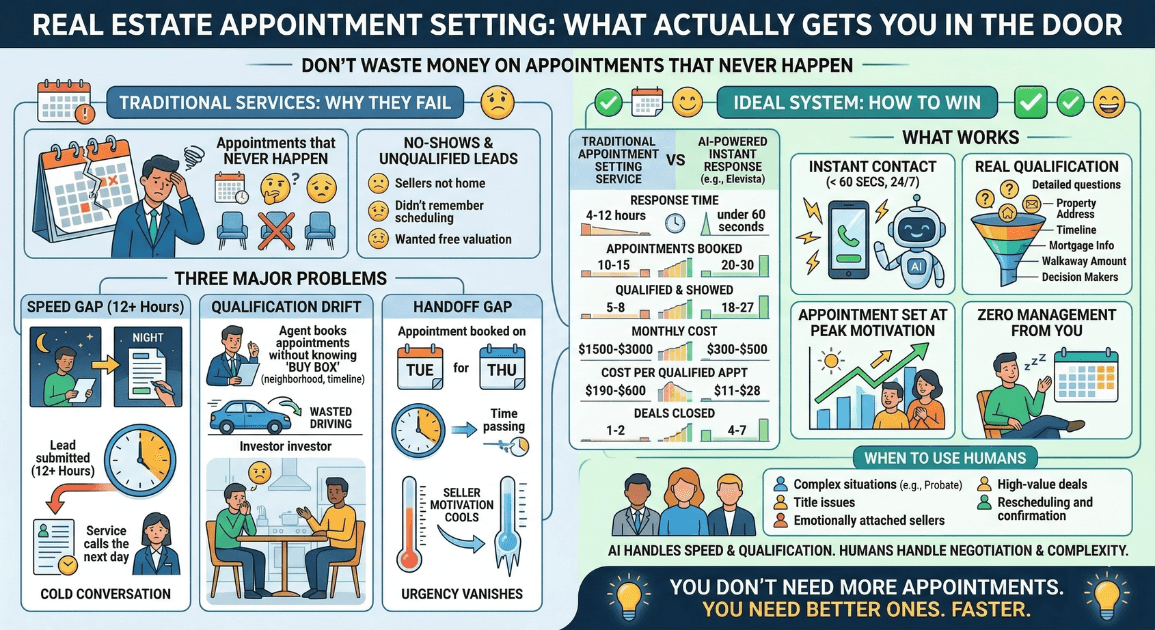
Why Are You Paying for Appointments That Never Happen?
You hired an appointment setting service. They promised 15-20 meetings a month. First month, they delivered 12. Felt decent. Then you drove to those appointments. Three sellers weren't home. Two didn't remember scheduling anything. One thought you were a realtor coming to list the property.
The Hidden Cost of Unqualified Meetings
Out of 12 "appointments," you had maybe 4 real conversations. You closed one deal. The service cost you $1,500. The math worked, barely. But it felt like you were paying full price for half a product.
Why This Pattern Keeps Repeating
That's the dirty secret of most real estate appointment setting services. The appointments get booked. They just don't show up, aren't qualified, or weren't real meetings in the first place. According to Salesforce's State of Sales report, sales reps across industries spend only about 28% of their time actually selling, with the rest consumed by unproductive activities and poor-quality leads.
How Do Real Estate Appointment Setting Services Actually Work?
Most real estate appointment setting services follow a simple model: you send them leads, they call the leads, and they try to book meetings on your calendar. Some services generate their own leads. Some only work leads you provide. Either way, the core product is someone calling sellers on your behalf to get you in the door.
The Call Center Model
Overseas teams working scripts. High volume, low cost per call. They'll dial 200 numbers a day and set whatever sticks. The problem is quality. These callers don't understand your market, your buy box, or the difference between a motivated seller and someone killing time on the phone. You get volume. You don't get vetted meetings.
The Dedicated Agent Model
A U.S.-based caller assigned to your account. Better conversations, but limited hours. They work their shift (usually 4-6 hours a day) and your leads outside those hours wait. Cost runs $2,000-$4,000/month. Quality is better than a call center, but you're still dependent on one person's availability, mood, and tenure.
The Pay-Per-Appointment Model
You only pay when a meeting gets booked. Sounds great until you realize the incentive structure is broken. The service gets paid for booked appointments, not closed deals. So they book everything: marginal leads, unqualified sellers, people who said "sure" just to get off the phone. You pay $75-$150 per appointment and half of them are worthless.
All three models share the same fundamental flaw: they separate the response from the qualification. Someone calls, someone books, and then you show up hoping the appointment is real.
What Are the Three Biggest Problems With Traditional Appointment Setting?
Even the best traditional real estate appointment setting services create three problems that eat into your results. Understanding these problems is the first step toward solving them.
Problem 1: The Speed Gap
You generate a lead at 9 PM. The appointment setting service doesn't start calling until 9 AM the next morning. That's a 12-hour gap. The Lead Response Management Study from Dr. James Oldroyd at MIT found that the odds of qualifying a lead drop dramatically in the first five minutes after submission. The seller already talked to two investors who called last night. By the time your service dials, the conversation is cold and the seller has options.
Most appointment setting services operate on business hours. Your leads don't. That mismatch costs you the highest-motivation leads: the ones who submit at night because they can't sleep, the ones who fill out forms on Sunday morning because they've been stressing all weekend.
Problem 2: Qualification Drift
The person booking the appointment isn't the person sitting at the kitchen table. They don't know your buy box. They don't know which neighborhoods you target. They don't know whether a seller's timeline works for your operation.
So they book everything that sounds reasonable. You drive 45 minutes to meet a seller who wants full retail. You spend an hour with someone who won't sell for another two years. You sit across from a homeowner who thought this was a listing appointment. Each wasted meeting costs you 2-3 hours you could have spent on a deal that was actually closeable.
Problem 3: The Handoff Gap
The appointment gets booked on Tuesday for Thursday. Between those two days, the seller's motivation cools. They talk to a neighbor who tells them their house is worth more. They sleep on it and decide they're not ready. Research from HubSpot shows that lead engagement drops steadily with time. By the time you knock on the door, you're not meeting a motivated seller at peak urgency. You're meeting someone who vaguely remembers agreeing to a meeting and isn't sure why you're there.
What Does a Good Appointment Setting System Look Like?
Forget the service model for a minute. Think about what you actually need from an appointment setting system. Four criteria separate systems that work from systems that waste your time.
Instant Contact Within 60 Seconds
The lead submits. The phone rings. Not in 4 hours. Not the next morning. Within 60 seconds. The seller is still sitting at their computer, still thinking about their problem, still in the emotional state that made them reach out.
Real Qualification in the First Call
Not "are you interested in selling?" That's what the form already told you. Real qualification: What's the property address? What's your timeline? Is there a mortgage? What would you need to walk away with? Are there other decision makers? These questions determine whether a meeting is worth your time before anything hits your calendar.
Appointment Set at Peak Motivation
The best time to book an appointment is during the first conversation, when the seller's urgency is highest. Not two days later on a follow-up call. Not after a drip sequence warms them up. Right now, while they're engaged and ready.
That's the standard. Any real estate appointment setting service that doesn't hit all four criteria is leaving money on your calendar and wasting time on your schedule.
How Does the Math Compare Between Traditional Services and Instant Systems?
Let's run the comparison on 100 leads a month using industry benchmark data.
Traditional Appointment Setting Service
- Response time: 4-12 hours (next business day for after-hours leads)
- Appointments booked: 10-15
- Appointments where seller actually shows and is qualified: 5-8
- Cost: $1,500-$3,000/month
- Cost per qualified appointment: $190-$600
- Deals closed: 1-2
AI-Powered Instant Response
- Response time: under 60 seconds, 24/7
- Appointments booked: 20-30
- Appointments where seller actually shows and is qualified: 18-27
- Cost: $300-$500/month
- Cost per qualified appointment: $11-$28
- Deals closed: 4-7
Why the Gap Is So Large
Same leads. Same market. The difference is speed, qualification quality, and coverage hours. The National Association of Realtors reports that buyers and sellers increasingly expect rapid digital responsiveness, and the investors who deliver it capture a disproportionate share of deals.
When Should You Keep a Human in the Loop?
AI handles the first 60 seconds and the qualification call better than any appointment setting service. But there are situations where human follow-up adds real value.
Complex Seller Situations
A seller going through probate with three siblings who all need to agree. A property with title issues that need explanation. A seller who's emotionally attached and needs time. These conversations benefit from a human touch after the AI has done the initial qualification.
High-Value Deals
If a lead qualifies and the deal could be worth $50,000+, a personal follow-up call from you or your acquisitions manager before the appointment reinforces the relationship and reduces no-show risk.
Rescheduling and Confirmation
An automated confirmation 24 hours before the appointment reduces no-shows by 30-40%, according to appointment reminder research from healthcare and service industries. This can be handled by AI or by a human. Either works.
The pattern: AI handles speed, volume, and initial qualification. Humans handle negotiation, relationship, and complex situations. Most real estate appointment setting services get this backwards. They use humans for the high-volume first call (where speed matters most) and leave the complex stuff to whoever shows up at the appointment.
Frequently Asked Questions
How much should I expect to pay for a real estate appointment setting service?
Traditional services range from $1,500 to $4,000 per month. Call centers sit at the lower end with high volume and low quality. Dedicated U.S.-based agents cost $2,000-$4,000/month with better conversations but limited hours. Pay-per-appointment models charge $75-$150 per meeting, though many booked appointments are unqualified. AI-powered systems like Elevista cost $300-$500/month and deliver higher qualification rates with 24/7 coverage.
What is the biggest problem with pay-per-appointment models?
The incentive structure is misaligned. The service gets paid for booked appointments, not closed deals. This creates pressure to book every lead regardless of qualification, resulting in marginal sellers, no-shows, and wasted drive time. You end up paying for quantity instead of quality, and your effective cost per deal skyrockets.
How important is response speed for appointment setting?
Response speed is the single most important factor. Research from the Lead Response Management Study shows that leads contacted within 60 seconds convert to appointments at 15-25%, compared to 1-2% for leads contacted the next morning. No amount of qualification skill or closing technique can overcome a multi-hour response delay.
Should appointment setters qualify leads before booking meetings?
Absolutely. Thorough qualification on the first call is what separates productive meetings from wasted drives. Key questions include property address, selling timeline, mortgage status, price expectations, and whether other decision makers are involved. Investors who qualify harder upfront typically see fewer total appointments but more deals closed, because every meeting they attend has real potential.
Can AI appointment setting work for high-end real estate deals?
AI excels at the first contact, qualification, and booking stage regardless of deal size. For high-value deals ($50,000+ profit potential), the best approach combines AI for speed and initial qualification with a human follow-up call before the appointment. This hybrid model captures the speed advantage of AI while adding the relationship building that high-value sellers appreciate.
Try Elevista free and get qualified appointments booked automatically →
Know investors wasting money on appointment setting services that deliver no-shows? Join the Elevista Partner Program and earn recurring commissions every time you refer someone who's ready to stop paying for meetings that don't happen.
Get insights delivered weekly
Join real estate investors who get speed-to-lead strategies and product updates every week.