
Best Real Estate CRM Alternatives for Investors Who Actually Want to Close Deals
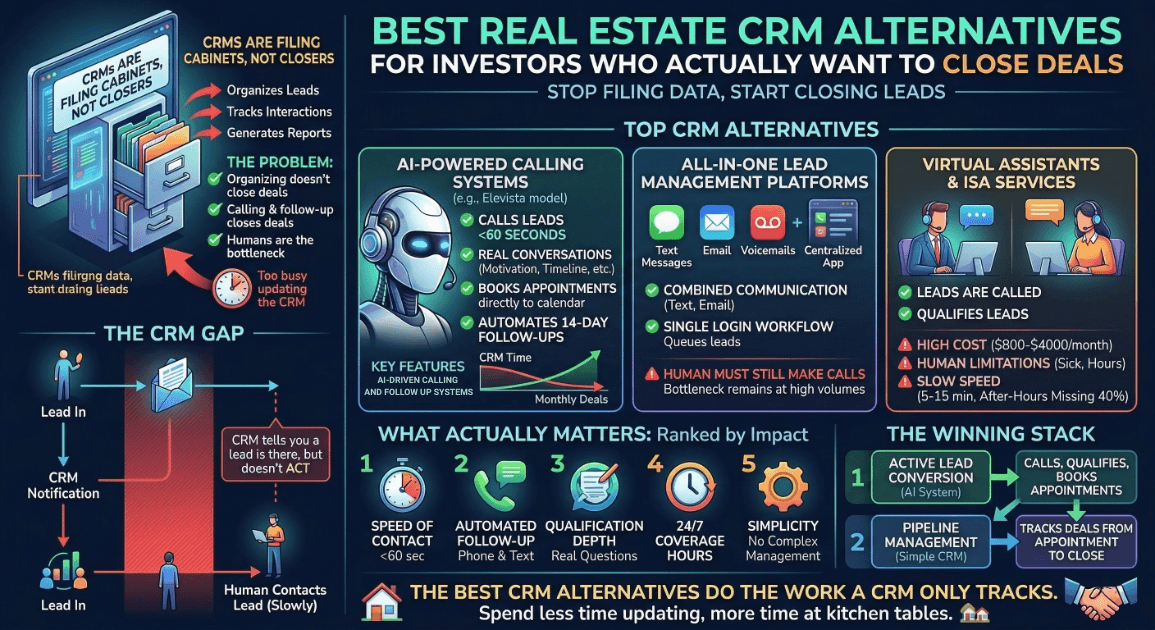
Is Your CRM Actually Helping You Close Deals?
Your CRM is a filing cabinet, not a closer. You spent two weeks setting up custom fields, pipeline stages, tags for every lead source, automated status changes, and color-coded labels. The whole system organized, documented, and ready to go.
The Gap Between Organization and Conversion
Six months later, you have 1,400 leads in the database. You can sort them by source, date, status, and zip code. You can pull a report showing exactly how many leads came in last Tuesday.
You're closing the same 3 deals a month you were closing before you set it up.
Why Organized Data Does Not Equal Closed Deals
The CRM did exactly what it was designed to do. It organized your data. The problem is that organizing data doesn't close deals. Calling leads closes deals. Following up closes deals. Having conversations closes deals. Your CRM doesn't do any of that. It watches you do it, or more accurately, watches you not do it because you're too busy updating the CRM.
That's why investors are looking for the best real estate CRM alternatives. Not because CRMs are bad tools. Because they're the wrong tool for the job that actually matters.
What Does a CRM Actually Do (and What Can It Not Do)?
CRMs are databases with a user interface. They store contact information, track interactions, and move leads through pipeline stages. Good ones integrate with your email and phone. Great ones generate reports that tell you where your leads come from and how fast they're moving through your funnel. According to Salesforce's State of Sales report, high-performing sales teams are 1.5x more likely to base decisions on CRM data.
None of them pick up the phone.
The Action Gap in Every CRM
Here's the gap that every real estate CRM leaves open: the CRM tells you that a lead came in 4 minutes ago. It doesn't call that lead. It shows you that a follow-up is due. It doesn't make the follow-up. It flags that 47 leads haven't been contacted in over a week. It doesn't contact them.
The Scoreboard Problem
The CRM is the scoreboard. You're still the player. And when you have 100+ leads a month, being the player on every play isn't sustainable. A NAR Technology Survey found that while most agents use some form of CRM or contact management, the majority still struggle with consistent lead follow-up.
This is why the best real estate CRM alternatives aren't better databases. They're systems that do the work your CRM only tracks.
How Do AI-Powered Calling Systems Replace CRM Busywork?
The most direct CRM alternative for real estate investors is a system that handles the work a CRM can't: calling leads, qualifying them, and booking appointments.
How It Works in Practice
Here's what this looks like. A lead fills out your form. Instead of landing in a CRM queue waiting for you to call, the system dials the lead in under 60 seconds. A conversation happens: property details, timeline, motivation, mortgage situation. If the lead qualifies, an appointment lands on your calendar with full notes. If they don't answer, the system runs a follow-up sequence over the next 14 days.
No CRM required for this workflow. The lead goes from form submission to booked appointment without you logging in, clicking anything, or picking up your phone.
Real Results: From CRM Updates to Closed Deals
An investor in St. Louis was paying $150/month for a real estate CRM and spending 3 hours a day updating it: logging calls, moving leads between stages, setting follow-up reminders. He switched to an AI calling system for his first-touch and follow-up workflow. The system handled the calls, the qualification, and the booking. His CRM usage dropped to 15 minutes a day, just checking his calendar and reviewing appointment notes. His monthly deals went from 4 to 7. Not because he had better data. Because the leads were getting called instead of categorized.
When AI and CRM Work Together
The CRM didn't go away entirely. He still uses it for long-term pipeline tracking. But it went from being his primary tool to a background reference. The AI system became the primary workflow.
Are All-in-One Lead Management Platforms Worth It?
Some investors replace their CRM with platforms that combine lead capture, communication, and automation in one system. These tools handle texts, emails, voicemails, and sometimes calls, all triggered by lead behavior. G2's CRM market research shows that all-in-one platforms are among the fastest-growing segments in real estate technology.
One System, One Login
The advantage over a standalone CRM is that the communication happens inside the platform. You're not logging into a CRM, then switching to your dialer, then switching to your texting app, then back to the CRM to log what happened. One system. One login. One workflow.
The Human Capacity Bottleneck
The limitation is that most of these platforms still require you to make the calls. They'll queue your leads and auto-dial the next number, but you're still the one talking. That works at 30 leads a month. At 100, you're back to the same bottleneck: too many leads, not enough hours, and the platform dutifully tracking all the leads you're not getting to.
All-in-one platforms are a step up from a standalone CRM because they reduce tab-switching and manual logging. They're not a full solution because they don't solve the human capacity problem.
Should You Hire Virtual Assistants or ISA Services Instead?
Another CRM alternative is outsourcing the calling to humans. ISAs (Inside Sales Agents) or trained virtual assistants call your leads, qualify them, and book your appointments.
The Upside: Someone Is Calling
This works better than a CRM alone because at least someone is calling. The leads aren't sitting in a database aging out.
The Downsides: Cost, Hours, and Speed
The downsides are real, though. Good ISAs cost $2,000 to $4,000 per month. Virtual assistants are cheaper ($800 to $1,500 per month) but less skilled. Both have human limitations: they work set hours, they get sick, they quit, they need management. And speed to lead is hard to guarantee. Even a dedicated ISA takes 5 to 15 minutes to respond to a new lead.
An investor in Baltimore was using a CRM plus a part-time ISA. The ISA handled callbacks during business hours. Average response time: 12 minutes. Leads that came in after 6 PM or on weekends sat until the next business day. He was converting leads at about 4%, better than doing it himself at 2.5%, but still leaving money on the table during the 14 hours a day the ISA wasn't working.
Combining AI With Human Agents
He added an AI calling system for the instant callback and after-hours coverage. The ISA still handled some daytime follow-ups. But the first call, the one that matters most, happened in under 60 seconds regardless of when the lead came in. His conversion rate went from 4% to 9%. The combination worked better than either system alone.
What Should You Look For in a CRM Alternative?
If you're evaluating the best real estate CRM alternatives, here's what actually matters, ranked by impact on deals closed:
Speed of First Contact
Does the system call leads within 60 seconds? Research from InsideSales.com (now XANT) shows that this single factor has more impact on conversion than every other feature combined. If the "alternative" still relies on you or a human to make the first call, your speed is capped by human availability.
Automated Follow-Up and Qualification Depth
Does the system handle the full follow-up sequence automatically? Six touches over 14 days, phone and text, without you scheduling reminders or making manual calls.
Does the system ask real qualifying questions: property details, mortgage, timeline, motivation, decision makers? A system that books unqualified appointments wastes your time the same way a CRM full of uncontacted leads does.
Coverage and Simplicity
Does the system work 24/7? Industry estimates suggest that around 40% of motivated seller leads come in outside business hours. A CRM alternative that only works 9 to 5 leaves the same gap your CRM does: leads aging overnight.
The best CRM alternative is one you don't have to manage. If you're spending an hour a day configuring workflows, updating automations, and troubleshooting integrations, you've replaced one administrative burden with another.
When Do You Still Need a CRM?
Not every investor should ditch their CRM entirely. There are legitimate use cases where a database adds value.
Legitimate CRM Use Cases
Long-term pipeline tracking across complex multi-deal operations, team coordination where multiple people need visibility, and reporting on cost per lead and marketing channel ROI are all valid reasons to keep a CRM. HubSpot's CRM adoption research confirms that CRMs excel at providing team-wide visibility and historical reporting.
The Key Insight
But notice what all three of those use cases have in common: they're about tracking and visibility, not about converting leads. The CRM serves the business after the lead has been contacted and qualified. It's not the tool that should be handling the contact and qualification.
The best real estate CRM alternatives don't replace your CRM. They replace the work your CRM was never designed to do.
What Does the Highest-Converting Investor Stack Look Like?
The highest-converting investors run a two-layer system:
Layer 1: Active Lead Conversion
An AI system that calls every lead in under 60 seconds, qualifies with real questions, books appointments automatically, and runs the full follow-up sequence for non-connects. This is the engine. This is where leads become meetings.
Layer 2: Pipeline Management
A CRM, simple, not elaborate, that tracks deals from appointment to close. Pipeline stages, deal values, team assignments, closing timelines. This is the dashboard. This is where you see the business.
Why Layer 1 Is Where Most Investors Are Weakest
Layer 1 is where most investors struggle. They have Layer 2 down. The CRM is set up, the pipeline is defined, the tags are organized. But the leads sitting in that beautiful pipeline are cold because nobody called them fast enough.
Elevista is Layer 1. Every lead gets called in under 60 seconds. Every conversation qualifies on the details that matter. Every qualified lead hits your calendar with property address, motivation, timeline, mortgage details, and decision makers. Your CRM handles the rest: tracking the deal from appointment through closing.
You stop spending 3 hours a day updating your CRM. You start spending those 3 hours at kitchen tables with sellers who are ready to talk.
Frequently Asked Questions
What is the best alternative to a CRM for real estate investors?
The best CRM alternative for real estate investors is an AI-powered calling system that contacts leads within 60 seconds, qualifies them with real questions, and books appointments automatically. Unlike a CRM, which only stores and organizes data, an AI system handles the actual outreach that converts leads into meetings.
Can I use a CRM and an AI calling system together?
Yes. The highest-converting investors run a two-layer system: an AI calling system for first contact and follow-up (Layer 1), and a simple CRM for tracking deals from appointment to close (Layer 2). The AI handles lead conversion while the CRM handles pipeline visibility.
How much do ISA services cost compared to AI calling systems?
ISA services typically cost $2,000 to $4,000 per month for skilled agents, while virtual assistants range from $800 to $1,500 per month. AI calling systems are generally more cost-effective, offer 24/7 coverage, and respond to leads faster since they are not limited by human availability.
Why does speed to lead matter more than CRM features?
Research from InsideSales.com shows that leads contacted within the first minute convert at dramatically higher rates than those contacted even an hour later. No CRM feature, no matter how sophisticated, can compensate for a slow first response. Speed of first contact has more impact on deal conversion than any other single factor.
What should I look for when evaluating CRM alternatives?
Prioritize speed of first contact (under 60 seconds), automated multi-touch follow-up sequences, deep qualification questions (property details, mortgage, timeline, motivation), 24/7 coverage, and simplicity. The best alternative is one you do not have to spend time managing.
What Is the Bottom Line on Choosing a CRM for Real Estate Investors?
The best real estate CRM alternatives aren't better databases. They're systems that do what databases can't: call leads, have conversations, and book meetings.
Your CRM tells you a lead came in. It doesn't call them. It reminds you to follow up. It doesn't follow up. It shows you a pipeline full of leads. It doesn't convert any of them.
Stop looking for a better way to organize leads. Start looking for a better way to contact them.
Try Elevista free and replace CRM busywork with booked appointments →
Know investors who spend more time updating their CRM than talking to sellers? Join the Elevista Partner Program and earn recurring commissions every time you refer someone who's ready to close deals instead of color-code them.
Get insights delivered weekly
Join real estate investors who get speed-to-lead strategies and product updates every week.