
Is Your Script Really the Problem, or Is Your Timing Off?
You downloaded seven motivated seller scripts from seven different gurus. You practiced them in the car. You taped one to your monitor. You memorized the opening line, the transition questions, the trial close.
The Four-Hour Callback
Then you called a lead back four hours after they filled out your form, delivered the script flawlessly, and got: "I'm not really sure I'm ready to do anything right now."
The script was fine. The window was closed.
Why Timing Beats Wording
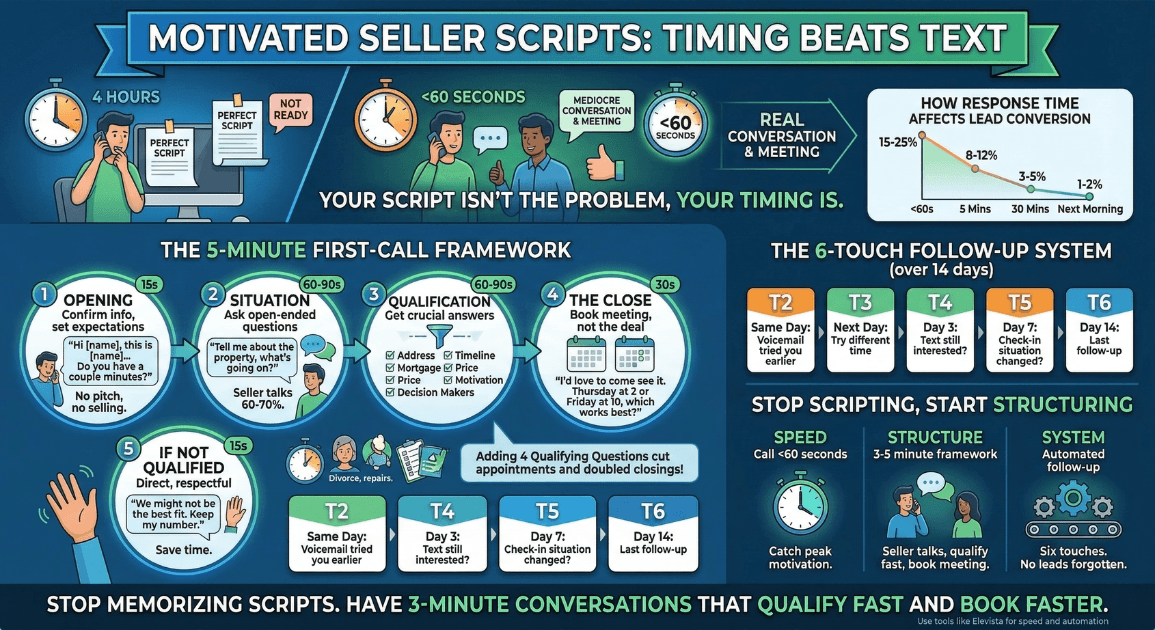
Here's the uncomfortable truth about motivated seller scripts: the best script in the world, delivered 2.1 hours late (the industry-average response time), loses to a mediocre conversation that happens in the first 60 seconds. Research from the Harvard Business Review confirms that leads contacted within five minutes are dramatically more likely to convert than those reached even 30 minutes later. Sellers don't convert because you said the right words. They convert because you caught them at the right moment and had a real conversation instead of a performance.
That doesn't mean scripts are useless. It means most investors are optimizing the wrong variable. They're polishing their lines when they should be fixing their speed.
What Does a Good Motivated Seller Script Actually Do?
Forget the word "script" for a moment. What you need is a conversation framework: a structure that keeps you on track without making you sound like you're reading off a card.
It Gets the Seller Talking
The biggest mistake in any motivated seller script is too many statements and not enough questions. "We buy houses fast and can close in 14 days" is a pitch. "Tell me about the property, what's going on with it?" is a conversation. Sales research from RAIN Group shows that top performers ask more questions and listen more actively than average performers. The seller should be talking 60-70% of the time on the first call. If you're doing most of the talking, you're selling. Sellers don't want to be sold. They want to be heard.
It Qualifies Without Interrogating
You need answers to five or six questions before you book a meeting: property address, timeline, mortgage situation, price expectations, motivation, and decision makers. But rattling them off like a census form makes the seller feel processed. The framework weaves qualification into a natural conversation. "What's your timeline looking like?" feels different from "When do you need to sell by?" Same information. Different energy.
It Books the Meeting, Not the Deal
The first call isn't a negotiation. It's a 3-5 minute conversation that determines whether a face-to-face meeting is worth both your time. The script that tries to get a verbal offer accepted on call one scares sellers away. The script that books a kitchen table conversation for Thursday at 2 PM is the one that closes deals.
What Is the 5-Minute First-Call Framework?
Here's the framework that works. Not because the words are magic, because the structure is right.
Opening (15 Seconds)
Reference the form. Confirm the person. Set the expectation. "Hi, this is [name] calling about the property you just inquired about. Is this [seller name]? Great. I just have a few quick questions to see if we might be able to help. Do you have a couple minutes?"
No pitch about your company. No explanation of your process. No "we buy houses in any condition" speech. The seller filled out a form. They know why you're calling. Get to the conversation.
Situation Questions (60-90 Seconds)
Open-ended, not yes/no. "Tell me about the property, what's the situation?" Then listen. The seller will tell you most of what you need to know if you let them talk. They'll mention the divorce, the inheritance, the vacancy, the repairs they can't afford. Your job is to listen and ask one or two follow-ups: "How long has that been going on?" or "What have you tried so far?"
Qualification Questions (60-90 Seconds)
Now you get specific. "What's your timeline, are you looking to move on this in the next few weeks, or is this more of a longer-term thing?" "Is there a mortgage on the property?" "Have you had any idea what you'd want to walk away with?" "Is there anyone else who'd need to be on board with a decision?"
These questions aren't optional. They're the filter between a meeting that closes and a meeting that wastes your afternoon. An investor in Cleveland was running 22 appointments a month and closing 3 deals. He was booking meetings with anyone who'd say yes. He added four qualifying questions to his first-call framework: timeline, mortgage, price expectation, and decision makers. Appointments dropped to 14. Deals went up to 6. He cut his drive time in half and doubled his closings.
The Close (30 Seconds)
If the seller qualifies, book the meeting. Don't explain your process. Don't pitch your offer range. Don't send them to your website. Book it. "Based on what you've told me, I think we can probably help. I'd love to come take a look at the property and talk through your options in person. I have time tomorrow at 2 or Thursday at 10, which works better?"
Two options. Not "when are you free?" Not "I'll send you some information first." A choice between two specific times. This books meetings. Open-ended availability doesn't.
If They Don't Qualify (15 Seconds)
Be direct and respectful. "Based on what you've shared, I don't think we'd be the best fit for your situation right now. But if anything changes, you have my number." No long explanation. No soft-pedaling. Sellers respect directness. And you just saved yourself a 2-hour round trip to a meeting that was never going to close.
Why Do Scripts Fail When Speed Fails?
Here's where motivated seller scripts intersect with the variable that actually determines conversion: response time.
The Shrinking Window
The best framework in the world assumes the seller is still in the conversation. That they're sitting at their computer, still feeling the urgency that made them fill out the form. That they remember who you are and what they submitted.
That's true at 60 seconds. It's half-true at 10 minutes. It's barely true at an hour. And it's false the next morning.
The Numbers Don't Lie
The data is consistent across multiple studies on lead response time. Leads contacted within 60 seconds convert to appointments at 15-25%. At 5 minutes: 8-12%. At 30 minutes: 3-5%. Next morning: 1-2%. Your script doesn't change across those time windows. The seller's willingness to engage does.
A Real-World Example
An investor in Cincinnati had a solid script. He'd practiced it. His close rate on connected calls was good, one in four conversations turned into an appointment. The problem was he was only connecting on 30% of his callbacks because he was calling 2-6 hours after submission. Most sellers didn't answer. The ones who did were already cooling off.
He moved first-call responsibility to an AI system that called every lead in under 60 seconds. The script the AI used wasn't dramatically different from his. But the connection rate went from 30% to 65% because sellers were still at the computer when the phone rang. Same framework. Different timing. His monthly appointments went from 8 to 19.
The script was never the bottleneck. The clock was.
How Is the Follow-Up Script Different from the First-Call Script?
Most guides on motivated seller scripts give you one script and call it done. That ignores the reality that most leads don't convert on the first call. They convert on touch 4, 5, or 6.
The Follow-Up Framework
The follow-up framework is simpler and shorter than the first call. You're not starting from scratch. You're referencing a previous conversation or attempt.
Follow-up touch 2 (same day, 4-6 hours later): "Hi [name], I tried you earlier today about [property address]. Just circling back. Give me a call when you have a minute." Voicemail only. Don't re-pitch. Short and specific.
Follow-up touch 3 (next day): Same approach. Different time of day. If they didn't answer at 10 AM, try 3 PM. "Still trying to connect about [address]. I'll try you one more time this week."
Follow-up touch 4 (day 3, text): First text in the sequence. "Hi [name], I've been trying to reach you about [address]. Still interested in chatting? Happy to work around your schedule."
The Final Touches
Follow-up touch 5 (day 7): "Checking in on [address]. If your situation has changed, no worries at all. If you'd like to talk, I have time this week."
Follow-up touch 6 (day 14): "Last follow-up on [address]. If you want to revisit this down the road, you have my number."
Six touches. Fourteen days. The key is consistency: every lead gets all six, not just the ones you feel like calling. For the full system behind this sequence, How to Follow Up with Real Estate Leads has the complete breakdown.
Why Should You Stop Scripting and Start Structuring?
The investors who close at the highest rates don't have better motivated seller scripts. They have three things working together.
Speed, Structure, and System
Speed. The first call happens in under 60 seconds. Not because the script requires it, because the seller's psychology demands it. You catch them at peak motivation or you don't catch them at all.
Structure. The conversation follows a framework: open, listen, qualify, book. No monologue. No pitch. No 10-minute explanation of how wholesaling works. Three to five minutes. Seller talks most. You book or you don't.
System. The follow-up runs automatically. Six touches over 14 days. No leads forgotten. No callbacks missed because you got busy. Every lead gets the full treatment.
How It All Comes Together
Elevista handles the speed and the system. Every lead gets called in under 60 seconds. The qualification follows the framework: situation, timeline, mortgage, price, decision makers. Qualified sellers get booked on your calendar with full details. The follow-up sequence runs automatically for every lead that doesn't convert on the first call.
You handle the kitchen table. The negotiation. The relationship. The close. That's where your skills matter.
Frequently Asked Questions
What is the best opening line for a motivated seller call?
Keep it simple and reference the form they filled out: "Hi, this is [name] calling about the property you just inquired about. Is this [seller name]?" Don't pitch your company or explain your process. The seller knows why you're calling. Get to the conversation within 15 seconds.
How do I handle a seller who wants to know my offer on the first call?
Redirect to booking a meeting. "I'd need to see the property before I could give you an accurate number. That's why I'd love to come take a look. I have time tomorrow at 2 or Thursday at 10." Giving a number before seeing the property either lowballs them (killing trust) or overcommits you.
Should I use the same script for every type of motivated seller?
Use the same framework, but listen for what's driving their motivation. A foreclosure seller needs to hear about speed and certainty. An inherited property seller needs to hear about simplicity and handling everything. The four qualifying questions stay the same. The emphasis shifts based on their answers.
How many times should I follow up before giving up on a lead?
Six touches over 14 days is a proven cadence. After six attempts across phone, voicemail, and text, you've given the seller every reasonable opportunity to engage. If they haven't responded, tag them for a 90-day revisit and move on.
Can AI really replace a human on the first call?
AI handles the first call well because it's the most structured, time-sensitive part of the process. The opening, situation questions, qualification, and booking follow a predictable framework. Where human skill matters most is the face-to-face appointment: reading body language, building rapport, and negotiating. AI handles the speed; you handle the relationship.
What Is the Bottom Line on Motivated Seller Scripts?
Motivated seller scripts matter, but not the way most investors think. The words are the least important part. The structure, the speed, and the consistency are what book meetings.
Stop memorizing scripts. Start having 3-minute conversations that qualify fast and book faster. And stop having those conversations four hours after the lead comes in. The best framework in the world doesn't work on a seller who's already moved on.
Speed first. Structure second. System always.
Try Elevista free and turn every lead into a qualified conversation in under 60 seconds →
Know investors who rehearse scripts but still can't book meetings? Join the Elevista Partner Program and earn recurring commissions every time you refer someone who's ready to stop scripting and start closing.
Frequently Asked Questions
Do motivated seller scripts actually work?
How long should a first call with a motivated seller take?
What is the ideal follow-up sequence for leads who don't convert on the first call?
How much does response time affect lead conversion rates?
Should the seller or the investor do most of the talking on the first call?
Get insights delivered weekly
Join real estate investors who get speed-to-lead strategies and product updates every week.